



Technological progress changes our world in big ways. But what drives this constant growth? It’s not just one thing; it’s a mix of many forces working together.
Innovation comes from a blend of economic needs, scientific breakthroughs, and human dreams. These forces push technology to keep moving forward.
Knowing what drives technology shows us how big leaps happen. It shows how market needs, new research, and social wants all play a part in our progress.
The path of technological growth is complex. It’s a team effort where many parts come together to bring about real change.
The Fundamental Question: What Drives Technology Forward
Innovation happens where need meets imagination. It’s our ongoing quest to better our lives, solve problems, and unlock new abilities through tech.
Defining Technological Progress and Innovation
Technological progress means creating and using new tools and methods to improve our lives. True innovation goes beyond just inventing something new. It’s about using these new ideas in ways that bring real value.
To understand defining innovation, we must see its many sides. Innovation includes:
- Technical improvements that make things better or more efficient
- Using old tech in new ways
- Big changes that alter how we tackle challenges
This broad view shows innovation isn’t just about new gadgets. It’s also about improving processes, systems, and even social tech that moves us forward.
Historical Perspectives on Technological Advancement
Looking back at the history of technology shows us what drives us forward. Each era has built on what came before, answering the needs and chances of its time.
Related Posts:
- How Technology Has Impacted Business The Digital…

- How Technology Affects Social Interaction Changing…

- The Negative Effects of Technology on Education…

- What Is HyFlex Technology Hybrid Flexible Learning Models

- What Industry Is Dell Technologies In Computers and…

- What Is Health Information Technology HIT Managing…

The Industrial Revolution changed everything with machines, steam power, and factories. It showed how tech can greatly boost production and change the economy.
In the Digital Age, we’ve seen computing, connectivity, and info tech open up new doors. This shows how tech builds on itself, leading to more advanced innovations over time.
Patterns of Innovation Through Centuries
Looking at tech history, we see patterns that shape today’s innovation. Key patterns include:
- Accumulative knowledge: Each generation adds to what came before
- Cross-pollination: Mixing tech from different fields leads to breakthroughs
- Accelerating pace: Tech changes faster and faster
- Societal adaptation: Good tech fits with culture and economy
These patterns show that tech progress is never alone. It’s a mix of human creativity, existing knowledge, and current needs that push tech forward through history.
Economic Forces: Market Demands and Financial Incentives
Human curiosity and scientific discovery start the journey of innovation. But, economic forces are what turn ideas into real products. The mix of market needs and financial rewards drives technology forward.

Capital Investment and Venture Funding
Big money is key for tech growth. Research and development need a lot of cash before they start making money. Venture capital is a game-changer here.
Venture funding helps both new and big companies take on big tech projects. This money lets them:
- Pay top talent well
- Buy the latest tools and materials
- Test and make prototypes
- Grow their production
Investors and innovators work together well. This partnership has brought many new ideas to life.
Market Competition as Innovation Catalyst
Competition is a big driver in tech. Companies try to beat each other with better products and services. This push to be the best makes technology better with each new product.
“Competition brings out the best in products and the worst in people.”
The smartphone world shows how competition works. Companies keep trying to be better, making phones more advanced.
Case Study: Smartphone Industry Evolution
The mobile phone market has changed a lot because of competition. Early phones were just for calls. Now, they’re like small computers.
This fast change is because of the need to be better. Apple’s iPhone in 2007 changed what people wanted. Then, others had to keep up, making things even better.
Some big changes include:
- Touchscreens instead of keyboards
- Cameras as good as cameras in cameras
- Computers in phones that can run lots of apps
- Batteries that last longer
Every new thing came from companies wanting to be the best in a crowded market.
Price-Performance Ratios Driving Progress
What people get for their money is another big driver. The price-performance ratio shows how much you get for your money. Companies always try to make this ratio better.
This idea explains why phones today are more powerful and cheaper than before. Companies that offer more value get more customers. This makes them want to keep getting better.
| Year | Average Price | Processing Power | Storage Capacity |
|---|---|---|---|
| 2010 | $600 | 1 GHz | 16 GB |
| 2015 | $650 | 2.5 GHz | 64 GB |
| 2020 | $700 | 3.5 GHz | 128 GB |
| 2023 | $750 | 4.5 GHz | 256 GB |
The table shows how prices and what you get for your money have improved. You get more tech for a little more money each year. This is good for both buyers and sellers.
Money drives a cycle of innovation. Investment leads to new ideas, which makes competition stronger. This makes prices better, which attracts more money. This cycle keeps pushing tech forward in many areas.
Scientific Discovery and Research Foundations
Technology advancement is driven by more than just market forces. It’s rooted in the systematic pursuit of knowledge through scientific discovery. This layer of exploration often starts without immediate commercial goals. Yet, it lays the groundwork for tomorrow’s innovations.
Basic Research as Innovation Bedrock
Basic research is the pure quest to understand nature and science’s fundamental principles. It’s different from applied research, which targets specific problems. This exploratory work looks into the why and how of natural phenomena.
This type of research doesn’t aim for immediate products or services. Instead, it builds the knowledge base for later use. The journey from discovery to application can take decades. So, investing in basic research is key for long-term technological growth.
University and Institutional Contributions
Academic institutions and research organisations are key to scientific progress. They foster curiosity-driven exploration and train the next innovators.
These places offer the necessary infrastructure, equipment, and networks for breakthroughs. The exchange of ideas across disciplines often leads to innovations that no single industry would have pursued alone.
Notable Examples: Internet and GPS Technologies
The internet and GPS technologies show the power of institutional research. The internet started with ARPANET, funded by the US Department of Defense through university partnerships.
GPS technology also came from military research but was built on fundamental physics and mathematics work at universities. Both technologies now support many industries worldwide, showing how special research can benefit everyone.
Government-funded Research Programmes
National governments are vital in supporting large-scale research that private entities can’t do alone. These programmes tackle complex challenges that need long-term effort and lots of resources.
Organisations like the National Science Foundation (NSF) and National Institutes of Health (NIH) in the US are key. They fund basic research, enabling scientists to explore high-risk, high-reward projects.
This ongoing investment in R&D creates a flow of discoveries that change industries. The partnership between public funding and academic expertise drives technological revolutions that shape our world today.
Human Curiosity and Intellectual Pursuits
Every great technological leap starts with our drive to explore and improve our world. This curiosity goes beyond money or rules, showing the true spirit of innovation.
The Role of Individual Inventors and Visionaries
History shows us how special people have changed technology with their vision and hard work. These innovators often work alone, driven by their own dreams, not just company goals.
Today, leaders like Satya Nadella at Microsoft show how one person can change a whole company. They see new possibilities and inspire teams, making a big difference.

Problem-Solving as Innovation Driver
Fixing problems is a key way to create new technology. This approach turns curiosity into real solutions that help people.
The best innovators know technology should serve people first, not just show off technical skills. This focus on people makes sure new ideas really help us.
Thomas Edison’s Systematic Approach
Edison developed a method for inventing that involved endless testing and solving problems. His lab in Menlo Park was like a factory for new ideas, tackling big challenges.
He said, “I have not failed. I’ve just found 10,000 ways that won’t work.” This shows how sticking with it and trying again leads to progress.
Modern Innovators like Elon Musk
Today, people like Elon Musk are tackling big challenges with new technology. Musk’s work on energy, space, and transport shows how one person can make a big difference.
His mix of technical knowledge and big dreams shows that human drive is key to progress. These innovators prove that solving big problems is all about human ambition and creativity.
| Aspect | Historical Innovators | Modern Visionaries |
|---|---|---|
| Primary Motivation | Practical problem-solving | Transformative impact |
| Working Method | Systematic experimentation | Cross-disciplinary integration |
| Resource Access | Limited personal funding | Venture capital ecosystems |
| Impact Scale | Industry-specific changes | Global systemic transformation |
| Collaboration Model | Small team workshops | International talent networks |
The table shows how innovation has always been driven by humans, even as the world changes. Both old and new innovators are sparked by human curiosity to turn problems into chances.
This thread of passion and problem-solving keeps technology focused on people. The best ideas often start with a simple “What if?” question, not just “What’s profitable?”
Societal Needs and Global Challenges
Throughout history, big problems have led to amazing tech breakthroughs. When we face big challenges together, innovation is often the best way to respond. This section looks at how today’s big issues drive new tech.
Addressing Environmental Concerns
As we become more aware of climate change and damage to our planet, green tech is growing fast. Companies are changing how they work to be kinder to the environment without losing efficiency. This change is a big step towards solving global problems.
Now, being green is a key part of business plans. Many companies think about the environment when they make new products. This shows how big issues can change whole industries and spark new ideas.
Healthcare and Medical Advancements
Medical tech moves fast when we need to solve health crises or deal with long-term problems. The health sector shows how big needs can change what we research and how fast we develop new things. Tech solutions often come from working together between scientists, institutions, and businesses.
COVID-19 Pandemic and Vaccine Development
The COVID-19 pandemic was a huge challenge that brought scientists together like never before. Companies, research groups, and governments worked fast to make vaccines. Their quick work showed how fast we can adapt when we have to.
This effort showed how urgent needs can speed up rules and spark new ideas. What used to take years was done in months, all while keeping safety first. It showed our ability to quickly change and adapt when faced with big threats.
Sustainable Technology Initiatives
Some companies are leading the way with green tech plans. IKEA is a great example of how businesses can tackle environmental issues through innovation. They’ve put a lot into using renewable energy, recycling, and making products that are better for the planet.
Other big efforts include:
- Creating packaging that can break down naturally
- Making production processes that don’t harm the environment
- Using water-saving tech
- Improving ways to store renewable energy
| Initiative Type | Primary Benefit | Notable Examples | Impact Scale |
|---|---|---|---|
| Renewable Energy | Carbon Reduction | Solar panel integration | Global |
| Circular Economy | Waste Reduction | Product recycling programmes | Corporate |
| Sustainable Materials | Resource Conservation | Bamboo-based products | Industry-wide |
| Energy Efficiency | Cost Savings | Smart building systems | Regional |
These green tech efforts show how caring for the planet can lead to real innovation. Companies see that helping the environment is good for business and for doing the right thing. This means they keep investing in tech that’s good for both the planet and their bottom line.
Dealing with big issues and challenges keeps pushing tech forward in all areas. From health emergencies to environmental threats, these problems create opportunities for new ideas. The tech we develop often ends up helping in ways we didn’t expect.
Government Policies and Regulatory Frameworks
Market forces and human creativity drive technological progress. But, government policy shapes the innovation landscape. Regulatory frameworks set the rules, either helping or hindering progress.

Intellectual Property Protection Systems
At the core of innovation is strong IP protection. Patents, copyrights, and trademarks protect inventors’ work. They turn ideas into valuable assets.
The patent system is a key driver of innovation. It gives temporary monopolies on inventions. This lets companies get back their R&D costs.
As one expert said,
“Without proper IP safeguards, many groundbreaking technologies would never progress beyond laboratory concepts due to the fear of immediate replication by competitors.”
Research and Development Tax Incentives
Governments use R&D incentives to boost innovation. These tax credits lower the cost of research. This makes it easier for businesses to experiment.
These incentives work in two ways:
- Tax credits reduce tax liability based on R&D spending
- Enhanced deductions let companies write off more than 100% of qualifying research costs
These tools are key in long development cycles, like in pharmaceuticals and renewable energy.
Comparative Analysis: US vs European Approaches
The US and EU have different innovation policies. The US focuses on market-driven solutions with big R&D incentives. The EU has stronger regulations and standards.
IP protection systems differ:
- The US has a first-to-invent system with strong patent enforcement
- EU members aim for a balance between inventor rights and public access
- American R&D tax credits are very generous
- European systems mix tax incentives with direct funding
These approaches create different innovation environments. The US encourages fast commercialisation, while the EU supports incremental innovation. Both have led to great technological achievements.
The evolution of these policies shapes global tech development. Each region learns from the other, making innovation policies more sophisticated.
Cultural and Educational Influences
Cultural environments and educational systems are key to technological innovation. They shape our mindsets, encourage teamwork, and build the talent needed for new discoveries.
STEM Education Programmes
STEM education is vital for technological progress. It teaches critical thinking and problem-solving from an early age to university.
Countries that focus on science and maths education produce more innovators. These efforts create a talent pool ready to solve complex tech challenges.
Innovation Ecosystems and Silicon Valley Model
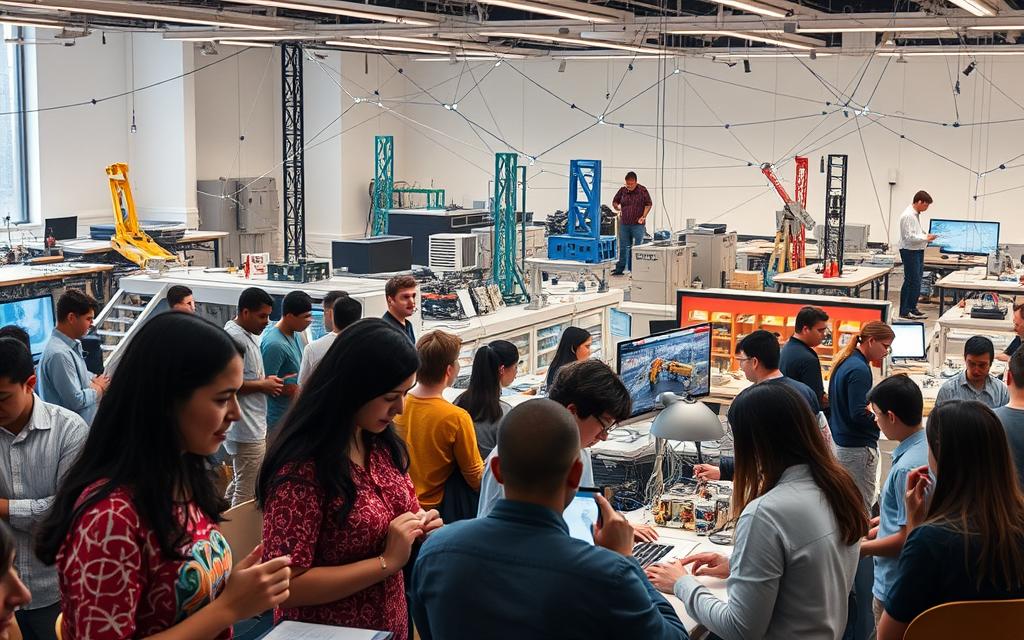
The Silicon Valley model shows how culture boosts tech progress. It values risk-taking, sees failure as a learning opportunity, and promotes collaboration between fields.
Successful innovation ecosystems share key traits:
- Strong partnerships between universities and industries
- Easy movement of talent between companies
- A culture of sharing knowledge and mentorship
- Access to various funding sources
Technology Hubs Around the World
Global tech hubs have adopted the Silicon Valley model. Each area develops its own strengths based on local culture and education.
Major innovation centres include:
- Cambridge Science Park in the United Kingdom
- Bangalore’s IT corridor in India
- Tel Aviv’s cybersecurity cluster in Israel
- Singapore’s biotech research corridor
These hubs show how cultural diversity and inclusive education lead to tech excellence worldwide.
Digital Transformation and Connectivity
The digital revolution has changed how we innovate today. It moved from closed systems to open ones. This change is a big driver of innovation now.

Internet and Global Information Exchange
The internet has made information sharing easy. People worldwide can share and build on each other’s work instantly. This speeds up solving problems and cuts down on repeating work.
Being connected globally brings different views together. A person in London can work with someone in Silicon Valley and another in Bangalore at the same time. This mix of ideas often leads to new discoveries that wouldn’t happen in one place.
Open Source Movements and Collaborative Development
The open source way of doing things is new. It’s about sharing and working together, not keeping things secret. This method has really helped technology grow in many areas.
Open source projects get help from many people. They find bugs, suggest improvements, and add new features. This way of working often makes things stronger and safer than when one group does it alone.
Linux and Wikipedia as Collaborative Models
Linux shows the power of open source. It started as one person’s project and now runs everything from phones to computers. It shows how a community can make something big and good.
Wikipedia is another example of how people can work together. It’s made by volunteers and is the biggest collection of knowledge ever. It shows how people can make something valuable without needing to be in charge.
Both Linux and Wikipedia work because of a few key things:
- They are open and transparent
- They value the best ideas
- They have good ways of making decisions
- They let others use and build on their work
These ways of working have changed many areas, including digital finance. They are changing how companies innovate today.
| Collaboration Model | Key Features | Impact on Innovation | Adoption Scale |
|---|---|---|---|
| Linux Development | Community contributions, open licensing | Enterprise software transformation | Global infrastructure |
| Wikipedia Editing | Volunteer editors, transparent revisions | Knowledge democratisation | Worldwide usage |
| Open Source Software | Public repositories, collaborative coding | Accelerated development cycles | Industry standard |
| Global Developer Communities | Distributed teams, shared standards | Cross-border innovation | Millions of contributors |
The success of these models shows that digital transformation is more than just technology. It’s about how we work together. The best innovations come from places that value openness and teamwork over keeping things secret.
As we get better at connecting and using digital tools, we’ll see even more big changes. The future of technology looks more open, global, and community-driven.
Conclusion
This summary shows how different things come together to move us forward. Economic benefits, scientific breakthroughs, and our curiosity are key. Society’s needs and government policies guide us.
Culture and digital links help us work together worldwide. It’s clear that success comes from understanding how all these parts work together.
Businesses need to be quick to adapt to these changes. Zoom’s fast move to remote work is a great example. On the other hand, X (Twitter) shows what happens when you ignore what people want.
As we look ahead, this mix of factors will grow stronger. It’s not just nice to have these drivers; it’s necessary for keeping up and moving forward.
FAQ
What are the primary drivers of technological advancement?
Technological progress is driven by many factors. These include economic needs, scientific discoveries, and human creativity. Societal demands, government policies, and education also play key roles. Digital connections help spread knowledge and ideas.
How does market competition influence innovation?
Market competition pushes companies to improve their products and services. This is to stay ahead in the market. For example, the smartphone industry’s fierce competition leads to quick technological updates.
Why is basic scientific research important for technological progress?
Basic scientific research is the base for new technologies. It has led to major breakthroughs like the Internet and GPS. These were made possible by public and academic funding.
What role do individual inventors play in innovation?
Individual inventors, like Thomas Edison and Elon Musk, bring new ideas to the table. Their creativity and drive often lead to groundbreaking discoveries.
How do societal challenges spur technological development?
Global issues like environmental problems and health crises motivate innovation. For example, the fast development of COVID-19 vaccines and sustainable projects by companies like IKEA show how urgent needs drive progress.
What impact do government policies have on innovation?
Government policies, such as patents and tax incentives for R&D, support innovation. They protect inventions and reduce financial risks for innovators.
How does education contribute to fostering innovation?
Education, mainly in STEM fields, prepares a skilled workforce for technological advancements. Programs in science, technology, engineering, and mathematics are essential for future innovation.
In what ways does digital connectivity accelerate innovation?
Digital connectivity, thanks to the internet, makes information accessible and enables global collaboration. Open source projects like Linux and Wikipedia show how shared knowledge can drive progress.
Are there specific regions known for fostering innovation?
Yes, places like Silicon Valley in the United States are known for their innovation. They support risk-taking, collaboration, and technological growth. These areas foster a culture that advances technology.
How do economic incentives like venture funding support technological development?
Venture funding and investment provide the money needed for research and development. This helps startups and big companies to bring new ideas to the market.
